Showing posts with label politics. Show all posts

Wednesday, May 30, 2012

Where's the Beef?

So the "Pasty Tax" U-Turn comes (or as I call it, the Sausage Roll). Rather too late to help the Tories through their little local election difficulties.

Paul Goodman has written a powerful piece giving a number of excellent reasons why the government shouldn't be u-turning - it would have raised much-needed revenue that the government will now have to find elsewhere, it makes ministers look weak, it makes loyal backbenchers (who've already voted it through) look ridiculous.

It was, however, inevitable that the government would have to buckle on this. It was an ill-considered policy, apparently foisted on the coalition by the Civil Service while they were asleep at the till (or in Osborne's case, on holiday). How do you judge whether something is "warm" or not without taking the temperature of every item? What is "room temperature" defined as? How many degrees from that temperature is an acceptable margin of error? Those conditions would have been difficult to comply with, but more importantly, they would have been impossible to enforce. (I'm not sure what the Civil Service was thinking of - perhaps issuing thermometers to HMRC inspectors?)

Nigel Lawson was wise enough to sidestep this quagmire when he first introduced VAT on hot food, writing:
"It does not apply to food and drink which has cooled to room temperature by the time it is sold, or to things like pies and pastries which are sold warm because they happen to be freshly baked, and not to enable them to be consumed while they are still hot."
Liberal Democrats are claiming victory on this, but I am rather suspicious. They have been in a bit of a muddle on this from start to finish - local candidates claiming the pasty tax was a Tory initiative (and that it would hurt "the Cornish pasty industry" - in spite of all the evidence that the only disadvantaged business would have been the Newcastle-based Greggs) when it was Lib Dem MPs who voted for it and Sarah Teather being the first politician to come out and justify the tax increase on Question Time.

In fact Teather's defence of the change was so thorough and heartfelt I wondered at the time whether this might be a Lib Dem initiative - after all it has all the hallmarks of a Lib Dem policy, a tinkering tax hike in the name of their warped sense of 'fairness'. On last Friday's edition of the Daily Politics, Toby Young gave some credence to this with a more developed theory of his own:
"I blame the Lib Dems. My theory is, we saw the Damian McBride blog in which he said the Treasury constantly produced this list, this wish list, of various taxes which he and Gordon Brown used to bat away. But I think what happened was, George Osborne announced quite late in the day that he wanted to cut the top rate of tax, so Danny Alexander and his team huddled with some Treasury officials, they said "well what can we ask for in return?" and the Treasury officials said "funny you should ask. We've got this list..." And then that's what the Lib Dems demanded as the price of accepting the tax cut."
It rings true to my ears...

Sunday, May 6, 2012

Mid-Term Blues: Ignore Them At Your Peril

Given Bruce Anderson's apparent proximity to Downing Street, this is an extremely depressing piece. If Labour had stuck their heads in the sand about dreadful council results like this, complacently accepting their losses as "mid-term blues" rather than evidence of a wider problem, they wouldn't have adjusted their activities in order to win their second or third terms, and they wouldn't have held the Conservative Party back from winning a majority in 2010.

The problems are threefold:
1) An unappealing and indistinct policy platform
2) Poor presentation by unpopular ministers
3) A dismally ineffective electoral machine

The fact is that when someone asks a canvasser "why should I vote Conservative", they are returned a blank expression. I couldn't think of a compelling reason (other than the excellent work of the sitting councillor, which sadly wasn't enough). There seems to have been a decision at the top that the Conservative Party should stand for nothing in particular, but to ordinary voters that has translated into "the Tories stand for no one, and certainly not us".

And the latter part of that is amplified when an extremely well-off Chancellor stands up at the despatch box, freshly returned from his American holiday, to announce that he's giving the highest earners an apparent tax break (although not by enough to return the rate to what it was two years ago and thereby silence his critics, thereby rendering the act both costly and pointless) while slapping VAT on the cheapest hot food on the high street (in the middle of the longest winter of recent memory). The troubles caused by Jeremy Hunt and the Home Office over the past couple of weeks wither in comparison to those caused by the Treasury.

Meanwhile, the party organisation is a basket case, particularly in the cities (those same cities that last week rejected Cameron's proposal of elected mayors), which are mostly comprised of constituencies without Conservative MPs, where the highly motivated union troopers outnumber the humble Tory leafletter by 14-1.
 
It occurred to me during the run-up to the last election that if the Tories can't run a party operation competently, how on earth can we expect them to run a government? Sadly it seems that fear was a justified one.

Monday, March 19, 2012

Quick response to Donal Blaney on wealth taxes

Just in case this doesn't get through comment moderation.
The campaign that is being led by Big Government Conservatives for a wealth tax (be it in the form of higher council tax for larger homes or a property tax on homes worth over £2m) is distinctly unconservative. 
No country has ever taxed itself into prosperity and no economy can properly grow if its wealth creators are strangled by a combination of personal, property, business and investment taxes, regulations and a climate hostile to success that class warriors have fought for years to bring about.
(Source.)
You're being disingenuous. For the most part, the Tories who advocate wealth taxes do so on the basis that it should replace some element of income tax. Not an additional tax on top. And surely it can't be the very principle of wealth being taxed at all that you object to, as you acknowledge in this very article that there are already forms of wealth tax in the United Kingdom. Or are you saying that something that has already been the status quo for many years should be seen as wholly unacceptable by "real" Tories?

Thursday, January 5, 2012

Not a follow-up to Iron Man


Should a film detailing Margaret Thatcher's dementia be released while she is still alive?


"The Iron Lady" seems, as a piece, to be making the point that the greatest minds succumb to the ravages of time. I can think of no worthier subject. By differentiating those points in her life so distinctly it becomes a portrayal that both strengthens her stature as a political icon and humanises her as she is now.

Though it would understandably be difficult for her family and friends to watch, from everything I've seen about the film it seems like a wonderfully imaginative way to tell her story.

And why should they wait until she's dead to release it when the creative world would otherwise see fit to drag her name through the mud at every possible opportunity...

Tuesday, November 15, 2011

Riposte II

Is this a spoof?

Regarding your four reasons for trusting Cameron, Osborne and Hague:

I will concede that the first reason, that they have sound judgement. (Albeit, as Iain Martin reminded us yesterday, this sound judgement usually arises only after a three year delay.)

I suppose I cannot deny your second reason, that they are courageous. (The most feeble election campaign in history, the slowest and smallest cuts programme imaginable, a disproportionately pro-Lib Dem coalition, ceding the terms of debate to Labour - all brave, ambitious decisions I'm sure.)

 I will wholeheartedly agree with the third reason that they are all profoundly patriotic (even if Cameron will sometimes refer to the English as Little Englanders, cede powers to the EU when we're not looking, and publicly belittle our standing in the world).

And as for your fourth and final reason, that they are "in possession of the facts"... I've got to wonder what it is they aren't telling us.

Monday, November 14, 2011

A riposte

Bruce Anderson:
"In response to such an account of Mr Cameron's electoral difficulties, some of the belly-achers become positively Bennite. David Cameron lost because he was not offering proper Toryism. He should have campaigned on scrapping the 50p rate and no ring-fencing for the NHS. If that had been the Tory platform, it is just possible that Gordon Brown might still be Prime Minister."

Complete and utter nonsense. Nobody is suggesting he should have campaigned on such a platform, because everybody recognises your statement of the obvious.

However: the 50p rate is economically illiterate, and there is a strong case for saying that bringing it back to 40p (where the rich still pays substantially more than anyone else) would mean everyone else would be required to pay less tax and receive more from their public services (and the economy in general). Nobody in the government is making this case, at least publicly, because the government is scared of making a complicated argument, even one that is eminently winnable. This is of course something they could be doing now they're in the first half of a term, rather than approaching a general election as you preposterously suggest. The challenge is to make the message about such a change being of benefit to the masses more than to the rich, and then hammer that message in relentlessly.

The NHS ring-fencing was recognised as an unaffordable promise early on and given that Labour was even ruling it out themselves the promise should probably have never been made. By defining himself around that message Cameron runs the risk of coming across as a promise-breaker. But worse, in defining public services by the amount of taxpayers' money poured into them, the Tories have been dancing to Gordon Brown's tune - when before, with the "more for less" stuff, Cameron showed so much promise of doing otherwise.

Nobody, anywhere, is saying either of these examples are "quick fixes" that would get the economy booming again. Trying to fix the economy at all is like trying to rotate Blackpool Tower 45 degrees using only a hammer and a screwdriver. But holding onto failed policies like 50p tax is like trying to do all that with a ball and chain attached to your foot. Pointless and irresponsible. And it's treating the voters like they're idiots who can't be persuaded of anything.

Timing is everything in politics, and the time to make these arguments is now.

Thursday, October 6, 2011

The folly of talking about cuts


Why do politicians, journalists, lobbyists, activists and just about everyone talk about every kind of public spending alteration in the terms of "cuts" and "increases"? Totally in relativistic terms? I'm not even going to go into the debate about why these groups are relentlessly focussed on these inputs over what really matters, the outcomes. Why can't anyone in Britain have a genuine, analytical debate over what the appropriate level of spending, or taxation, is in any given dimension of the state?
Why does nearly every discussion start under the assumption that in pretty much every department the present state of affairs is the optimal status quo? Why are right-wingers advocating "lower taxes" rather than "low taxes", or at the very least talking about the level at which they think taxes should be appropriately set? Why are the numerous union activists chanting against "Tory cuts" spelling out in detail what they think the right level of public spending should be? (For that matter, we might as well ask, why did Labour cancel its last Comprehensive Spending Review? In doing so they completely absolved themselves of any fiscal credibility, passing the buck to their successors in every possible way.)
In fact why are the high-profile supposed Conservatives not making the case for right-wing policies, or further fiscal consolidation than is absolutely necessary? Do they seriously think that anyone who still supports them at this point would actually mind them going further with public sector spending cuts? Especially given there's a remarkably strong case that further such cuts are indeed necessary?
And on the speed of cuts as well. It has been reported to a moderate extent that had the Tories been in power alone, a hypothetical Tory majority government would have cut the entire deficit within the first year or so, and were held back by the Lib Dems. (I am mildly dubious about this because the Chancellor would still have been George Osborne, who was advocating Gordon Brown's spending plans until he decided it would be politically expedient to oppose them, rather too late.) That would presumably mean that by this point, today, in October 2011, we would be living in a United Kingdom with no national deficit at all. And government could plod along as usual without there being mandatory fiscal consolidation every single year. (By election time, most people would have forgotten there were any spending cuts at all!)
But, naturally, the mountain of debt would still remain - something that concerned me before the election, that Osborne's promise of eliminating the deficit was oversold, we need to be in substantial surplus for a long enough time before we can start making a serious dent into that mountain. And back here in reality, the real Osborne is borrowing more than ever before, with the debt mountain actually set to RISE by another £315 billion over the course of this parliament, to nearly £1.2 trillion. Which surely, we can all agree, is not an appropriate amount of debt for any country to be into...

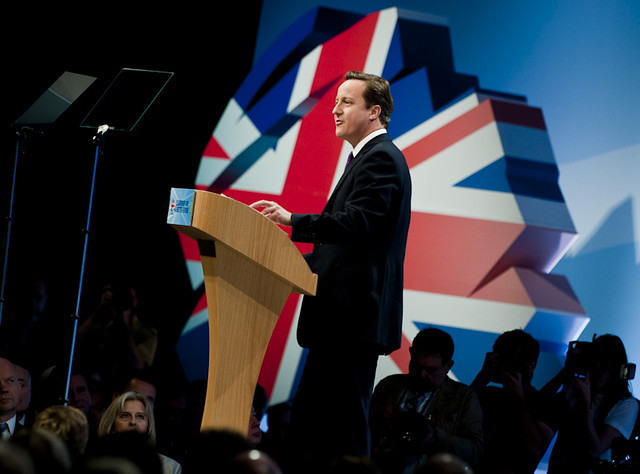
Cameron's speech

Photo by Nick Pickles

I think there's scope for saying that Cameron's speech as a whole, while not containing many passages about growth specifically, encapsulated what it actually takes for Britain's economy to grow. This was very much more a speech about the British public than it was the British government. And ultimately, it is the public that makes the economy run at all, not the government (and nor should it be the government), so why not put the emphasis on that?

At the very least it marks a difference from the previous government which took all the credit for growth - and subsequently, quite hypocritically, denied any blame for recession. (Labour likes to cite international factors as the reason for the recession, as though international trade had nothing to do with those continuous quarters of growth they boasted so gleefully about. That's when they're not pinning all the blame on the banks, where of course they had absolutely nothing to do with removing the one regulatory mechanism that would have prevented a cash flow crisis from emerging, as soon as they entered office.)

A visible British success on the international stage in Libya. A complete transformation in educational standards. A house-building revolution. A cut in burdensome health-and-safety regulation that causes more problems than it solves. A nation of good health. Where good leadership and initiative is encouraged, and promoted. Where the unemployed are ready to work, equipped with the skills and motivation they need to maximise their productivity, and Britain's with it. Where unwanted children are adopted, rather than left to the care of the state, while well-off British couples (such as David Miliband and his wife) travel overseas to adopt their own. Where young people have the discipline and the motivation that they need to succeed in life. Where marriage forms the bedrock of society (regardless of the sexual orientations of the couple involved). And all done without breaking the bank - that's the way to build a solid economic foundation for the future, not using the arms of the state to prop up failed businesses and hire workers to perform pointless tasks that often intrude into ordinary people's lives at times when they aren't welcome. It's what people do that matters, not what the state does.

In some ways it is a shame that Cameron didn't completely bring all these ideas together into the theme of their impact on economic growth, or pointing out that the "can-do" attitude can extend to what government is capable even when it's spending less overall (not that I'm convinced it is spending less overall, strictly speaking). But on the other hand, the speech was presented as a call to arms, a rallying cry to the nation, and when you're trying to address a wider audience, speaking in terms of economic jargon will rarely achieve the intended effect. (Not that there's any chance much of this wider audience will have seen the whole speech, but it's always worth putting the effort in!)

Sometimes what is needed is not a push, not a shove, but a poke, a whisper in the ear. The economy will only grow if people collectively will it to grow. And by setting an upbeat tone, with an outlook designed to motivate people into action, Cameron can probably achieve a lot more than a few dozen government initiatives. Let's just hope that the next round of GDP figures bear this out.

Friday, September 23, 2011

Me on Question Time


My bit is midway through part 2, where I call Harriet Harman on something she said toward the end of part 1. I remember seeing her physically recoil like a jack-in-the-box! (The camera doesn't quite capture this.) Watch the whole thing through if you'd like to see it in context. You can see me gawping throughout.

Choice twitter comments (using the #bbcqt hashtag):

Wednesday, September 14, 2011

George Osborne, 50p tax etc

Westminster needs to stop looking at any 50p tax abolition as a tax cut and start looking at it as the end of a tax hike. At 40% high earners would still be paying a higher proportion of their income than everyone else and it is to Osborne's shame that he's never put it in these terms.

George Osborne is extremely wealthy and yet does not suffer from the 50% rate as his wealth is derived from family rather than current earnings - and yet he uses his enormous wealth as an excuse to bash the aspirational. He is a petty little man and a weak Chancellor.

Monday, February 7, 2011

10 O'Clock Live

Just out of mindless curiosity I filled in a survey about Channel 4's new satirical offering, 10 O'Clock Live. (The survey at one point includes a revealing list of the show's regular contents, evidently cribbed from the run-sheet.) Unsurprisingly I got a bit carried away with the "additional feedback" form, which apparently is shared with Channel 4 executives. Given they are likely to balk at the ridiculous length of my critique, I share it here in the hope that at least SOMEONE will find it of enough interest to actually read and give feedback....


Top-tier talent wasted on dreadful writing. The jokes are rarely funny and never imaginative. The presenters work best in their off-the-cuff moments, reacting to things. Jimmy Carr is a brilliant talent who tells hysterically funny jokes in his stand-up work - perhaps he needs to work with the writing team more closely. (Perhaps you need a different writing team.)

Usually the bit that makes me laugh the most is the newspaper headlines at the end - usually just Charlie Brooker reading out the funniest headline. That doesn't reflect well on the writers, who unlike headline-writers are paid to come up with things designed to make us laugh.

It's all way too left-leaning - the guest discussions usually have a balanced panel but always hijacked by David Mitchell's Guardian-skewed viewpoint. This is just as prominent in his interviews: the first one, with David Willetts, was a relentless grilling, but actually shed some light on the subject that had got lost under all the broken promises, mindless slogans, smashed windows and poked Duchesses in other media coverage - despite Mitchell's attempts to create his own soundbites for the "case against". The second week, he didn't ask Alastair Campbell anything he hadn't already been asked a million times over (Iraq, Iraq, Iraq), giving him a pretty easy ride overall - due to Mitchell's predictable anti-war slant. And the Caroline Lucas interview was a bit of a love-in, Mitchell agreeing with her on virtually everything.

Also it's just plain weird seeing Mitchell without Webb, as an anchor at least...

I have no idea what Lauren Laverne is doing there. She doesn't add anything to the programme and her presence is a rather patronising (false) suggestion that there aren't any good female comedians out there. Some tension between the cast would be welcome too - they spend most of the programme looking at the camera rather than each other, usually saying very similar sorts of things, which can create a disturbing impression of a hive mind. A more stylistically and ideologically diverse cast would solve a lot of these problems - Mitchell, Brooker and Laverne are essentially cut of the same cloth, and this does not make for good chemistry (the Two Ronnies for example didn't share much in common beyond the same first name!).

"This Week" is on BBC One half an hour later and has for the past three weeks been a bit funnier and a lot more informative. That is what you are competing with.

Wednesday, December 29, 2010

Dire Straights

The Coalition government has appointed Simon Hughes to be its "Advocate for Access to Higher Education". This entails selling the recent tuition fees reforms to young people in order to encourage them to attend university.

Simon Hughes is, of course, a man who couldn't even persuade himself that these reforms are worthwhile enough to vote for them. He abstained.

This is surely the coalition's single most ridiculous appointment yet. Next they'll be inviting Ed Balls to be their Spending Cuts Advocate.

Norfolk Blogger has a similarly critical Lib Dem perspective on this here.

Monday, December 13, 2010

EMA protests kick off

Good grief. Educational Maintenance Allowance was only introduced a couple of years ago. And now it's seemingly introduced teenagers to welfare dependency. These protesters need to get a grip. Bribing these youngsters won't educate them, if they had any interest in further study they would just go anyway. Anyone who's attending college purely to receive EMA is just having their time wasted by the state when they could be entering employment or training.

Wednesday, November 10, 2010

Demo-lition!

It's been fascinating to watch the news all day. We saw people smashing up windows and the reception area to the 30 Millbank building (or was it Millbank Tower, the journalists couldn't quite make their minds up) - all in the name of protesting against increased student fees (although oddly I don't recall anyone doing anything like this when Labour introduced them in the first place, nor when they hiked them by a factor of three in 2005).

Strangest of all has been the reaction of the NUS (whose staff, wearing reflective jackets, were prominently on the scene when those windows were being smashed in). It is currently saying on its web site:

NUS has condemned the violent actions of "rogue protestors" who have undermined an otherwise peaceful protest with NUS President Aaron Porter calling the scenes "despicable".

Strange then that this afternoon, clicking on the "WE WILL MARCH" banner produced the following, at http://www.demo2010.org.uk/

With "DEMO-LITION" emblazoned all over it (as well on the NUS' official placards and t-shirts), it seems to me not so much a condemnation of violence as an incitement to it.

Of course during the course of the afternoon all trace of this site has mysteriously disappeared and the URL currently links straight through to nus.org.uk. Funny that. There's still a couple of "DEMO-LITION" badges tucked away on its front page though.

Pity the media hasn't made a point of this, they don't seem to like reporting on union hypocrisy very much for some reason...

On a related note, credit to the BBC who managed to find the perfect candidate to interview for the Six O'Clock News (long before the watershed): a man with "FUCK" scrawled all over his face. Very prominent on the analogue set I watched it on...

Update: they just showed him again on the News at Ten.

Friday, July 30, 2010

BBC's balanced welfare coverage

Looking at how the BBC has reported reaction to Iain Duncan Smith's welfare initiative:
http://www.bbc.co.uk/news/uk-politics-10807098

We're given reactions (both positive and negative) from only the following:
  • Will Hutton (left-wing)
  • Yvette Cooper (left-wing), speaking on behalf of Labour (left-wing)
  • SNP (left-wing)
  • Plaid Cymru (left-wing)
  • Brendan Barber (left-wing) speaking for the TUC (left-wing)
  • And a spokeswoman for the IPPR, which the BBC itself describes as "left-leaning".

Well if that's not what I call balance across the whole of the left-wing spectrum, I don't know what is! However, if we are to believe the BBC, nobody from the centre or the right of British politics has an opinion on this.

Saturday, July 24, 2010

Facebook recommends...

Facebook has been making this recommendation for a week or two now, which suggests to me that at this point any real distinction between the two main parties in British politics has become utterly superficial:

Friday, July 2, 2010

Why does Andy Burnham's appearance on "This Week" have all the hallmarks of a car crash?


Burnham's turn on "This Week" last night was an absolute disaster from start to finish. He completely misjudged the pace of the show in such a way that suggests he'd never watched the programme before. Right from the outset (not seen in the above video), when Andrew Neil asked him for his "moment of the week" and he read out three carefully prepared lines of anti-Tory rhetoric - lines designed to scare people, lines that everyone's heard before (from Harriet Harman and the other candidates), lines that impress no one - it was obvious he was in over his head. Even Portillo managed to eviscerate him.

The only glimmer of light was when he attacked the Tory policy of ringfencing health spending - a sensible position to take if only this wasn't the Shadow Health Secretary of a party that is trying to convince everyone that the government can afford to increase spending on every department. One is confused by the notion of a Labour politician calling for health spending to be cut (and one might further wonder what exactly Burnham achieved during his tenure as Health Secretary).

After Diane Abbott's mauling last week you've got to wonder why the other contenders are putting themselves through this. I suppose in the long run it might steel them up a bit as politicians, though in the age of Youtube (where your worst on-screen moments are recorded for eternal posterity) I somewhat doubt it. I can't wait to see what Neil and Portillo do to the brothers Miliband.

Saturday, April 24, 2010

Nick Clegg Part 2

(In response to this riposte.)

Why am I disturbed by Nick Clegg's spurious popularity - because of his plans to obliterate our democratic system and lock us into a ghastly alternative that protects, above all else, the vested interests - which at that point would include the Lib Dems.

Which "accusation" against Clegg is untrue? That government contractors paid money directly into his personal account? (The Lib Dems have confirmed this.) That he claimed three kitchens, cake tins, paper napkins and a rose for his wall garden on expenses? (Published in his expense accounts, confirmed by Clegg.) That his party received £2.4m from a convicted fraudster and never returned the money? (A matter of public record.)

Ashcroft has not lied to or cheated anyone - he never told anyone he was moving to the UK for tax purposes, he was never required to do that (everything he did was agreed with the government and they have confirmed that he acted above board the entire time) - and the fact is he's the only person in history who has been given a conditional peerage - Labour's Lord Paul, for example, hasn't been subject to similar standards (even though his situation, with stiffed employees and expenses claims added into the mix, is a decidedly dodgy one) - nor has he been subject to the kind of press scrutiny Ashcroft has despite being the Prime Minister's personal bankroller.

(By the way, Ashcroft does pay UK taxes on his UK earnings. He is taxed in each country his earnings are made, at the appropriate rate - why on earth should he pay another whack of tax on them again in the UK - surely that would come to 90% or something?)

Can you legitimately justify the weeks of coverage that story garnered? The story didn't even go anywhere, and was hardly relevant to the general populace - an obscure individual who hadn't broken any law. Nick Clegg is asking us to vote for him - so surely it is fair to ask him why he charged the taxpayer for business class flights when he flew economy class?

(Fortunately it looks like the supposed "Lib Dem surge" has subsided... polls have snapped back to what they were in March.)

Friday, April 23, 2010

When is a smear a smear?

I find it bizarre that lefty news organisations such as the Independent, the Guardian and the BBC came out yesterday against the "attacks" of "right-wing press" (I wasn't aware the Telegraph was right-wing any more, but never mind) against Nick Clegg. In fact pretty much all the reports were keen to present these attacks as "smears".

Firstly, this must be seen in the context of what the media also describes as "smears", specifically those seen in "Smeargate" wherein we learned that one of the Prime Minister's closest aides spent his time under Gordon Brown's employment making up nasty stories about Conservative MPs and circulating them to lefty hacks. These slanderous stories, which were self-evidently fictitious, were defined by the press as "smears" - fair enough.

However, in that context, it gives the impression that the stories about Nick Clegg's expenses (claiming to have his kitchen renovated three times - like any good Lib Dem he was obviously sitting on the fence about what it should look like), his views (expressing why Britain shouldn't proud of its role in WWII might be a noble discussion to articulate, but it is not becoming of someone who is asking to be our Prime Minister - or whatever it is he is asking us to do to him) and his financial arrangements (having donations made by government contractors into his private account might be above board, but it's an incredibly dodgy arrangement) are also of that nature - when in fact every single piece of it is from publicly documented evidence. And while Fleet Street hacks might be completely useless at a great number of things, they don't have a reputation for making stuff up.

And yet the likes of the BBC report these accusations as "smears" by the nasty right-wing press, the "Tory-supporting newspapers", as though these attacks have been co-ordinated by George Osborne himself. Ben Brogan says these aren't smears, this is scrutiny - and if the Liberal Democrats want to be taken seriously as a political party then they ought to expect rather a lot of that, because it's what David Cameron and Gordon Brown get the rest of the time (not least from them!!!).

But of course then the whole thing takes a rather deeper turn, with the Guardian and the Independent (not the BBC this time, this would be an editorialisation too far) out-and-out attacking their fellow newspapers (and Rupert Murdoch in particular) for going to such lengths to make 'their guy' look bad, as though they have never editorialised, as though they have never had an agenda to destroy an individual or a political force.

And yet you only need look six weeks into the past to see what complete and utter hypocrites they really are.

Over a decade ago, some bloke you've never heard of joined the House of Lords under a unique conditional arrangement that required him to take up permanent residence in the United Kingdom, and then, without telling anyone other than the government he was accountable to, took up a non-domiciled tax status. Everything he did was fully within the law (and indeed there are several other peers on all sides of the House who behave identically, although weirdly none of them have ever been given conditional peerages). However, the reason you're supposed to care about this? He took the Tory whip and donated shedloads to the party, and six weeks ago his tax status was forced into the public domain.

What's whiffy about the story is unclear but the fact that he'd kept his private tax information secret for all these years gave the left-wing press the opportunity to write as many nasty articles about Lord Ashcroft and the Conservative Party as they could think of. To the extent that even when there wasn't any more new information about Lord Ashcroft or the situation they still published a seemingly endless stream of highly-prominent articles at a fast pace, all of them claiming that Ashcroft had done something horribly wrong and many of them declaring that he should be sacked immediately.

Now, will the likes of the Indy admit the prominence and the frequency of those Ashcroft articles were a concerted effort designed to smear Ashcroft and damage the Conservative party in the run-up to a general election, hence making them complete hypocrites on this particular issue, or are they going to talk down to us as if we're all complete and utter morons? (and judging by the reaction to their attacks on Murdoch etc, it's entirely possible that for the most part they're right?)

Tuesday, December 1, 2009

The economic geniuses in the Lib Dems strike again

Apparently the Liberal Democrats have a policy handbook which states they are

“...the only party who would use Gordon Brown’s wasted billions to create thousands of jobs today by investing in homes, hospitals, schools and public transport...”


How can you use money that’s been wasted? Surely if it’s been wasted then it’s not and never will be available to use again?

I am increasingly convinced that Vince Cable understands public finance about as well as Gordon Brown ever has...