Thursday, January 5, 2012

Not a follow-up to Iron Man


Should a film detailing Margaret Thatcher's dementia be released while she is still alive?


"The Iron Lady" seems, as a piece, to be making the point that the greatest minds succumb to the ravages of time. I can think of no worthier subject. By differentiating those points in her life so distinctly it becomes a portrayal that both strengthens her stature as a political icon and humanises her as she is now.

Though it would understandably be difficult for her family and friends to watch, from everything I've seen about the film it seems like a wonderfully imaginative way to tell her story.

And why should they wait until she's dead to release it when the creative world would otherwise see fit to drag her name through the mud at every possible opportunity...

Tuesday, November 15, 2011

Riposte II

Is this a spoof?

Regarding your four reasons for trusting Cameron, Osborne and Hague:

I will concede that the first reason, that they have sound judgement. (Albeit, as Iain Martin reminded us yesterday, this sound judgement usually arises only after a three year delay.)

I suppose I cannot deny your second reason, that they are courageous. (The most feeble election campaign in history, the slowest and smallest cuts programme imaginable, a disproportionately pro-Lib Dem coalition, ceding the terms of debate to Labour - all brave, ambitious decisions I'm sure.)

 I will wholeheartedly agree with the third reason that they are all profoundly patriotic (even if Cameron will sometimes refer to the English as Little Englanders, cede powers to the EU when we're not looking, and publicly belittle our standing in the world).

And as for your fourth and final reason, that they are "in possession of the facts"... I've got to wonder what it is they aren't telling us.

Monday, November 14, 2011

A riposte

Bruce Anderson:
"In response to such an account of Mr Cameron's electoral difficulties, some of the belly-achers become positively Bennite. David Cameron lost because he was not offering proper Toryism. He should have campaigned on scrapping the 50p rate and no ring-fencing for the NHS. If that had been the Tory platform, it is just possible that Gordon Brown might still be Prime Minister."

Complete and utter nonsense. Nobody is suggesting he should have campaigned on such a platform, because everybody recognises your statement of the obvious.

However: the 50p rate is economically illiterate, and there is a strong case for saying that bringing it back to 40p (where the rich still pays substantially more than anyone else) would mean everyone else would be required to pay less tax and receive more from their public services (and the economy in general). Nobody in the government is making this case, at least publicly, because the government is scared of making a complicated argument, even one that is eminently winnable. This is of course something they could be doing now they're in the first half of a term, rather than approaching a general election as you preposterously suggest. The challenge is to make the message about such a change being of benefit to the masses more than to the rich, and then hammer that message in relentlessly.

The NHS ring-fencing was recognised as an unaffordable promise early on and given that Labour was even ruling it out themselves the promise should probably have never been made. By defining himself around that message Cameron runs the risk of coming across as a promise-breaker. But worse, in defining public services by the amount of taxpayers' money poured into them, the Tories have been dancing to Gordon Brown's tune - when before, with the "more for less" stuff, Cameron showed so much promise of doing otherwise.

Nobody, anywhere, is saying either of these examples are "quick fixes" that would get the economy booming again. Trying to fix the economy at all is like trying to rotate Blackpool Tower 45 degrees using only a hammer and a screwdriver. But holding onto failed policies like 50p tax is like trying to do all that with a ball and chain attached to your foot. Pointless and irresponsible. And it's treating the voters like they're idiots who can't be persuaded of anything.

Timing is everything in politics, and the time to make these arguments is now.

Sunday, October 9, 2011

Squashed Easter Eggs

Don’t read this article unless you’ve seen the last three minutes of Doctor Who series 6 as reading this article would otherwise completely ruin all of it.

And indeed be sure to watch it first as nothing in this will otherwise make a lick of sense to you.

(Continued in full at Bleeding Cool.)

Thursday, October 6, 2011

The folly of talking about cuts


Why do politicians, journalists, lobbyists, activists and just about everyone talk about every kind of public spending alteration in the terms of "cuts" and "increases"? Totally in relativistic terms? I'm not even going to go into the debate about why these groups are relentlessly focussed on these inputs over what really matters, the outcomes. Why can't anyone in Britain have a genuine, analytical debate over what the appropriate level of spending, or taxation, is in any given dimension of the state?
Why does nearly every discussion start under the assumption that in pretty much every department the present state of affairs is the optimal status quo? Why are right-wingers advocating "lower taxes" rather than "low taxes", or at the very least talking about the level at which they think taxes should be appropriately set? Why are the numerous union activists chanting against "Tory cuts" spelling out in detail what they think the right level of public spending should be? (For that matter, we might as well ask, why did Labour cancel its last Comprehensive Spending Review? In doing so they completely absolved themselves of any fiscal credibility, passing the buck to their successors in every possible way.)
In fact why are the high-profile supposed Conservatives not making the case for right-wing policies, or further fiscal consolidation than is absolutely necessary? Do they seriously think that anyone who still supports them at this point would actually mind them going further with public sector spending cuts? Especially given there's a remarkably strong case that further such cuts are indeed necessary?
And on the speed of cuts as well. It has been reported to a moderate extent that had the Tories been in power alone, a hypothetical Tory majority government would have cut the entire deficit within the first year or so, and were held back by the Lib Dems. (I am mildly dubious about this because the Chancellor would still have been George Osborne, who was advocating Gordon Brown's spending plans until he decided it would be politically expedient to oppose them, rather too late.) That would presumably mean that by this point, today, in October 2011, we would be living in a United Kingdom with no national deficit at all. And government could plod along as usual without there being mandatory fiscal consolidation every single year. (By election time, most people would have forgotten there were any spending cuts at all!)
But, naturally, the mountain of debt would still remain - something that concerned me before the election, that Osborne's promise of eliminating the deficit was oversold, we need to be in substantial surplus for a long enough time before we can start making a serious dent into that mountain. And back here in reality, the real Osborne is borrowing more than ever before, with the debt mountain actually set to RISE by another £315 billion over the course of this parliament, to nearly £1.2 trillion. Which surely, we can all agree, is not an appropriate amount of debt for any country to be into...

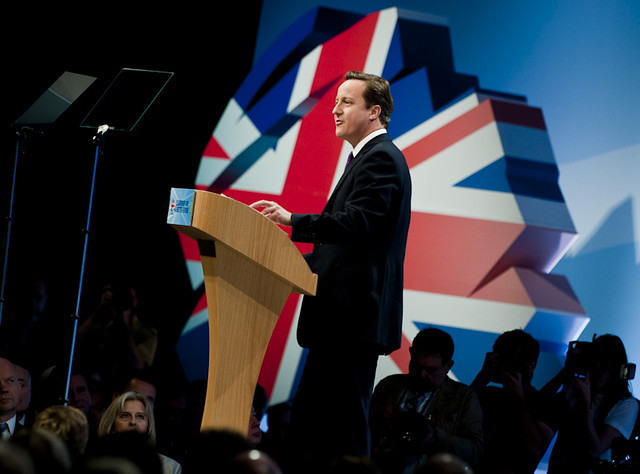
Cameron's speech

Photo by Nick Pickles

I think there's scope for saying that Cameron's speech as a whole, while not containing many passages about growth specifically, encapsulated what it actually takes for Britain's economy to grow. This was very much more a speech about the British public than it was the British government. And ultimately, it is the public that makes the economy run at all, not the government (and nor should it be the government), so why not put the emphasis on that?

At the very least it marks a difference from the previous government which took all the credit for growth - and subsequently, quite hypocritically, denied any blame for recession. (Labour likes to cite international factors as the reason for the recession, as though international trade had nothing to do with those continuous quarters of growth they boasted so gleefully about. That's when they're not pinning all the blame on the banks, where of course they had absolutely nothing to do with removing the one regulatory mechanism that would have prevented a cash flow crisis from emerging, as soon as they entered office.)

A visible British success on the international stage in Libya. A complete transformation in educational standards. A house-building revolution. A cut in burdensome health-and-safety regulation that causes more problems than it solves. A nation of good health. Where good leadership and initiative is encouraged, and promoted. Where the unemployed are ready to work, equipped with the skills and motivation they need to maximise their productivity, and Britain's with it. Where unwanted children are adopted, rather than left to the care of the state, while well-off British couples (such as David Miliband and his wife) travel overseas to adopt their own. Where young people have the discipline and the motivation that they need to succeed in life. Where marriage forms the bedrock of society (regardless of the sexual orientations of the couple involved). And all done without breaking the bank - that's the way to build a solid economic foundation for the future, not using the arms of the state to prop up failed businesses and hire workers to perform pointless tasks that often intrude into ordinary people's lives at times when they aren't welcome. It's what people do that matters, not what the state does.

In some ways it is a shame that Cameron didn't completely bring all these ideas together into the theme of their impact on economic growth, or pointing out that the "can-do" attitude can extend to what government is capable even when it's spending less overall (not that I'm convinced it is spending less overall, strictly speaking). But on the other hand, the speech was presented as a call to arms, a rallying cry to the nation, and when you're trying to address a wider audience, speaking in terms of economic jargon will rarely achieve the intended effect. (Not that there's any chance much of this wider audience will have seen the whole speech, but it's always worth putting the effort in!)

Sometimes what is needed is not a push, not a shove, but a poke, a whisper in the ear. The economy will only grow if people collectively will it to grow. And by setting an upbeat tone, with an outlook designed to motivate people into action, Cameron can probably achieve a lot more than a few dozen government initiatives. Let's just hope that the next round of GDP figures bear this out.